
From 1983 to 1986 Niki de Saint Phalle wrote and illustrated AIDS: You Can’t Catch It Holding Hands working with Swiss immunologist and AIDS specialist Prof. Silvio Barandun. Written in the form of a letter to her son Philip, she used her joyous style to deliver straightforward information about the transmission of HIV from unprotected sex and needle-sharing by intravenous drug us.

Aspen, published between 1965 and 1971, was a multimedia “magazine in a box” created by Phyllis Johnson. Each issue broke from traditional print by being curated by different artists and designers, including diverse materials such as booklets, vinyl records, film reels, and posters, showcasing avant-garde movements like pop art, Fluxus, and conceptual art. This issue features Carrol Baker, David T. Bazelan, James Blue, Robert Blumofe, Faubion Bowers, John Burchard, Peggy Clifford, Norman Corwin and more.

A 1969 artists’ book by one of the all time greats, this is de Saint Phalle’s love letter to Jean Tinguely, at once erotically charged and extraordinarily innocent. It is pure love, rendered in De Saint Phalle’s unmistakable hand - as good a book as artwork as there ever was.

S.M.S., founded in New York by William Copley with Dmitri Petrov, was a subscription-based “art in a box” series distributing small, often playful works by mail. Inspired by Marcel Duchamp, it mixed famous and emerging artists across disciplines, all paid equally. Designed to bypass the traditional art market, it fostered accessibility and a collaborative, communal creative environment. Contributors to issue #1 include Su Braden, James Byars, Christo, Walter de Maria, Richard Hamilton, Julien Levy, Kasper König, Sol Mednick, Irving Petlin, Nancy Reitkopf, La Monte Young and Marian Zazeela.

S.M.S., founded in New York by William Copley with Dmitri Petrov, was a subscription-based “art in a box” series distributing small, often playful works by mail. Inspired by Marcel Duchamp, it mixed famous and emerging artists across disciplines, all paid equally. Designed to bypass the traditional art market, it fostered accessibility and a collaborative, communal creative environment. Contributors to issue #2 include Nicolas Calas, Bruce Conner, Marcel Duchamp, Marcia Herscovitz, Alain Jacquet, Ray Johnson, Lee Lozano, Meret Oppenheim, Bernard Pfriem, George Reavey, and Clovis Trouille.

S.M.S., founded in New York by William Copley with Dmitri Petrov, was a subscription-based “art in a box” series distributing small, often playful works by mail. Inspired by Marcel Duchamp, it mixed famous and emerging artists across disciplines, all paid equally. Designed to bypass the traditional art market, it fostered accessibility and a collaborative, communal creative environment. Contributors to Issue #3 include Aftograf, Enrico Baj, John Battan, William Bryant, Dick Higgins, Joseph Kosuth, Ronnie Landfield, Roland Penrose, Man Ray, H. C. Westermann, Hannah Weiner, and Terry Riley.

S.M.S., founded in New York by William Copley with Dmitri Petrov, was a subscription-based “art in a box” series distributing small, often playful works by mail. Inspired by Marcel Duchamp, it mixed famous and emerging artists across disciplines, all paid equally. Designed to bypass the traditional art market, it fostered accessibility and a collaborative, communal creative environment.

S.M.S., founded in New York by William Copley with Dmitri Petrov, was a subscription-based “art in a box” series distributing small, often playful works by mail. Inspired by Marcel Duchamp, it mixed famous and emerging artists across disciplines, all paid equally. Designed to bypass the traditional art market, it fostered accessibility and a collaborative, communal creative environment. Contributors to Issue #5 include Angus MacLise, Edward Fitzgerald, Diane Wakoski, Mel Ramos, Bruce Nauman, Yoko Ono, Wall Batterton, Lawrence Weiner, Robert Rohm, William Schwedler and William Nelson Copley.
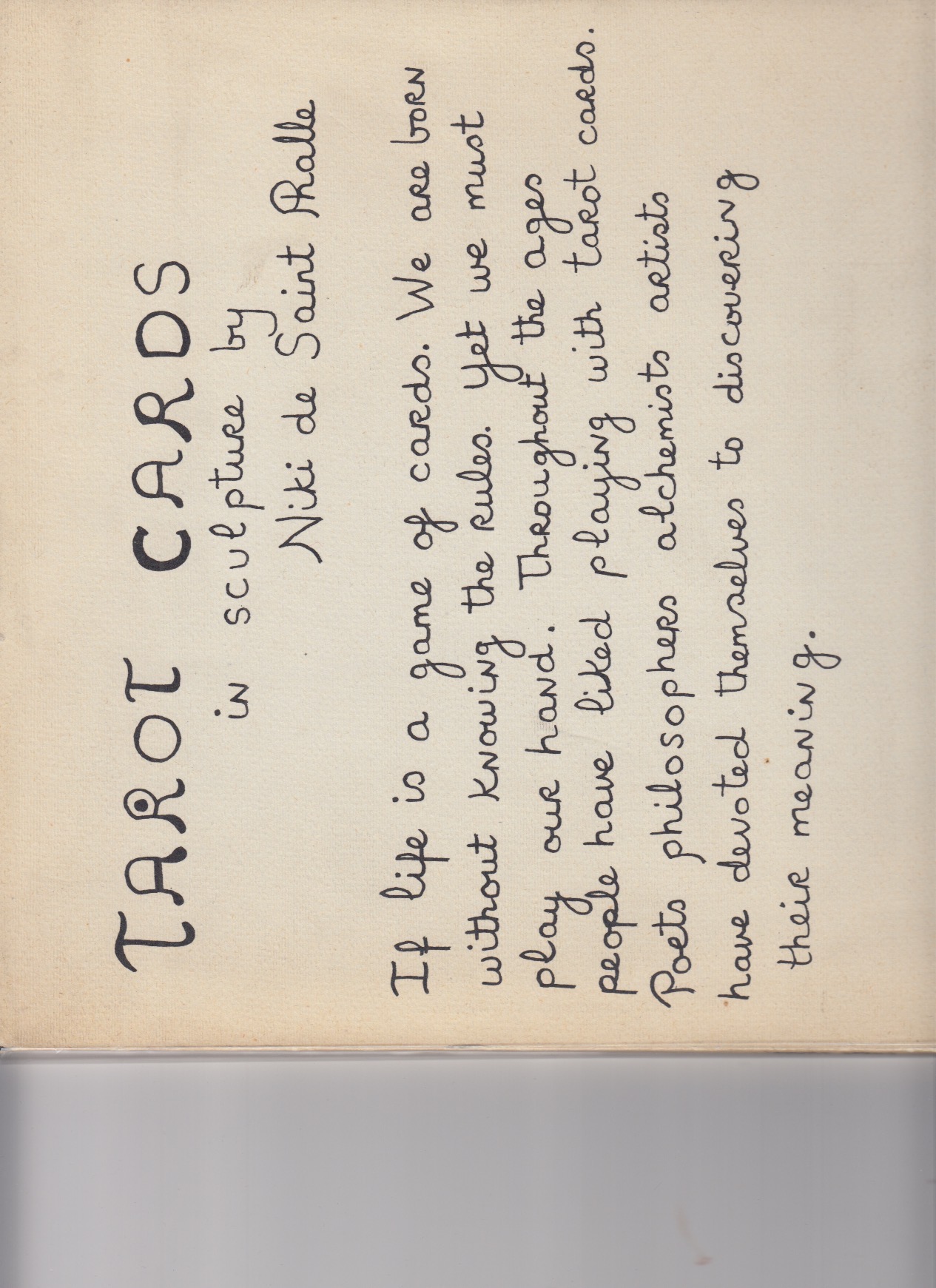
Made during the building of her Tarot Garden, this beautiful little book is de Saint Phalle’s explanation of her audacious and brilliant project, illustrated with her knowingly naive hand. Everything she touches is desperately romantic, endlessly alluring, perpetually profound.

Made during the building of her Tarot Garden, this beautiful little book is de Saint Phalle’s explanation of her audacious and brilliant project, illustrated with her knowingly naive hand. Everything she touches is desperately romantic, endlessly alluring, perpetually profound.

S.M.S., founded in New York by William Copley with Dmitri Petrov, was a subscription-based “art in a box” series distributing small, often playful works by mail. Inspired by Marcel Duchamp, it mixed famous and emerging artists across disciplines, all paid equally. Designed to bypass the traditional art market, it fostered accessibility and a collaborative, communal creative environment. Contributors to issue #2 include Nicolas Calas, Bruce Conner, Marcel Duchamp, Marcia Herscovitz, Alain Jacquet, Ray Johnson, Lee Lozano, Meret Oppenheim, Bernard Pfriem, George Reavey, and Clovis Trouille.

A 1969 artists’ book by one of the all time greats, this is de Saint Phalle’s love letter to Jean Tinguely, at once erotically charged and extraordinarily innocent. It is pure love, rendered in De Saint Phalle’s unmistakable hand - as good a book as artwork as there ever was.


S.M.S., founded in New York by William Copley with Dmitri Petrov, was a subscription-based “art in a box” series distributing small, often playful works by mail. Inspired by Marcel Duchamp, it mixed famous and emerging artists across disciplines, all paid equally. Designed to bypass the traditional art market, it fostered accessibility and a collaborative, communal creative environment. Contributors to Issue #5 include Angus MacLise, Edward Fitzgerald, Diane Wakoski, Mel Ramos, Bruce Nauman, Yoko Ono, Wall Batterton, Lawrence Weiner, Robert Rohm, William Schwedler and William Nelson Copley.

S.M.S., founded in New York by William Copley with Dmitri Petrov, was a subscription-based “art in a box” series distributing small, often playful works by mail. Inspired by Marcel Duchamp, it mixed famous and emerging artists across disciplines, all paid equally. Designed to bypass the traditional art market, it fostered accessibility and a collaborative, communal creative environment. Contributors to issue #1 include Su Braden, James Byars, Christo, Walter de Maria, Richard Hamilton, Julien Levy, Kasper König, Sol Mednick, Irving Petlin, Nancy Reitkopf, La Monte Young and Marian Zazeela.

From 1983 to 1986 Niki de Saint Phalle wrote and illustrated AIDS: You Can’t Catch It Holding Hands working with Swiss immunologist and AIDS specialist Prof. Silvio Barandun. Written in the form of a letter to her son Philip, she used her joyous style to deliver straightforward information about the transmission of HIV from unprotected sex and needle-sharing by intravenous drug us.

A collection of Niki de Saint Phalle's of surreal illustrations exploring various complex family dynamics.

S.M.S., founded in New York by William Copley with Dmitri Petrov, was a subscription-based “art in a box” series distributing small, often playful works by mail. Inspired by Marcel Duchamp, it mixed famous and emerging artists across disciplines, all paid equally. Designed to bypass the traditional art market, it fostered accessibility and a collaborative, communal creative environment.

Aspen, published between 1965 and 1971, was a multimedia “magazine in a box” created by Phyllis Johnson. Each issue broke from traditional print by being curated by different artists and designers, including diverse materials such as booklets, vinyl records, film reels, and posters, showcasing avant-garde movements like pop art, Fluxus, and conceptual art. This issue features Carrol Baker, David T. Bazelan, James Blue, Robert Blumofe, Faubion Bowers, John Burchard, Peggy Clifford, Norman Corwin and more.

S.M.S., founded in New York by William Copley with Dmitri Petrov, was a subscription-based “art in a box” series distributing small, often playful works by mail. Inspired by Marcel Duchamp, it mixed famous and emerging artists across disciplines, all paid equally. Designed to bypass the traditional art market, it fostered accessibility and a collaborative, communal creative environment. Contributors to Issue #3 include Aftograf, Enrico Baj, John Battan, William Bryant, Dick Higgins, Joseph Kosuth, Ronnie Landfield, Roland Penrose, Man Ray, H. C. Westermann, Hannah Weiner, and Terry Riley.